Frames Per Algorithm: The AI Tools Quietly Reshaping How Anime Gets Made
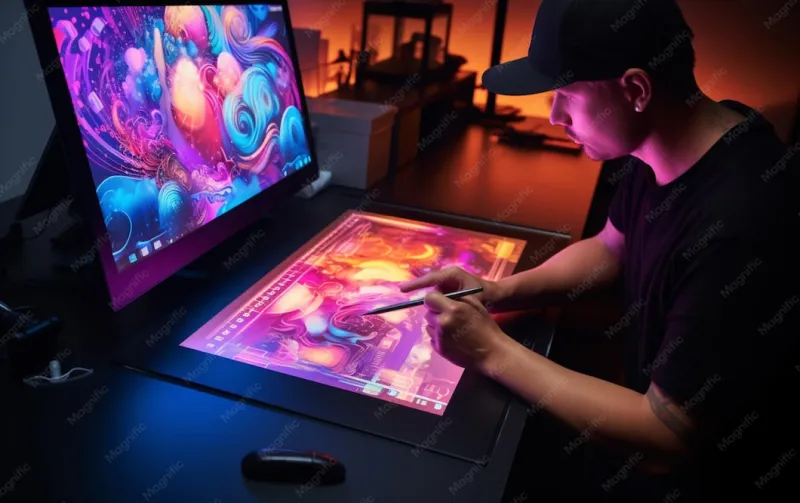
Photo: animator working at digital drawing tablet in dark studio with AI interface screens, via img.freepik.com
The conversation about AI in creative industries tends to run hot and abstract — lots of speculation, lots of fear, lots of hype. But inside Japanese animation studios right now, the conversation is quieter, more technical, and considerably more urgent. AI isn't coming to anime production. It's already there.
The question is what that actually means for the people who make the shows.
What's Already in the Pipeline
To understand where AI fits in anime production, it helps to understand how anime gets made in the first place. The process is famously labor-intensive and famously underpaid. Key animators — the artists responsible for the defining poses and motion arcs in a scene — work alongside "in-betweeners," junior animators who draw the frames that connect those key poses. It's meticulous, repetitive work, and it's often the lowest-paid role in the production chain.
This is precisely where AI tools have found their first real foothold.
Several studios and third-party vendors in Japan have been quietly testing and deploying AI-assisted in-betweening — software that generates the intermediate frames between key poses automatically, or at least reduces the number of frames that need to be drawn by hand. The results are imperfect but improving. For action sequences with relatively consistent motion, the tools can significantly reduce the workload. For complex, expressive character moments, human hands are still essential.
Background generation is another active area. Creating detailed, consistent backgrounds is enormously time-consuming, and some studios have begun using AI image generation tools — often built on models trained specifically on architectural and environmental reference — to produce base images that human artists then refine. It's a hybrid workflow, and it's spreading faster than most public reporting has captured.
Color correction and cleanup — the painstaking process of ensuring color consistency across thousands of frames — is also seeing AI integration, with tools that can flag inconsistencies and suggest corrections, reducing the time colorists spend on technical fixes rather than creative decisions.
The Efficiency Argument
Studios and production companies investing in these tools tend to make a consistent argument: anime production is broken, and AI helps fix it.
They're not entirely wrong about the first part. The production pipeline for TV anime in particular is notoriously brutal. Schedules are compressed, budgets are thin, and the workload regularly produces conditions that would be considered exploitative in most American entertainment contexts. Animators talk openly about working through the night on a regular basis, about being paid per frame at rates that don't reflect the hours invested.
In that context, tools that reduce the in-betweening burden or speed up background production look less like corporate cost-cutting and more like relief.
"If AI handles the mechanical parts of the job, animators can focus on the parts that actually require artistry," is roughly how the optimistic version of this argument goes. And there's something to it. The in-betweening grind has historically been a kind of hazing ritual — a rite of passage that burns out talented artists before they ever reach senior roles.
The Fear Is Real, and It's Specific
But the people most affected by these tools aren't necessarily reading the situation the same way.
For in-betweeners specifically, the concern isn't abstract. If AI handles in-betweening reliably, the entry-level pipeline that has historically trained junior animators disappears. The craft isn't just a job — it's how you learn. Take away the repetitive foundational work and you potentially take away the path to becoming a senior animator.
One animator who works at a mid-sized studio and asked to remain anonymous described the feeling this way: "We've been told the tools are there to help us. But I watch what's happening to the workload distribution and I don't see 'help.' I see fewer people being hired for the work I started on."
This echoes concerns that have surfaced in other parts of the entertainment industry as AI tools have scaled up. The fear isn't always "robots replace humans" in a dramatic, total-displacement sense. It's more granular than that — it's about which roles get hollowed out, which career pathways close, and who ends up bearing the cost of efficiency gains that mostly benefit studios and distributors.
The Transparency Gap
One of the more frustrating aspects of this moment is how little visibility there is into what's actually being used and where. Major studios have been largely tight-lipped about AI integration, partly for PR reasons and partly because the tools are often deployed through vendor relationships rather than internal development, making attribution murky.
There have been flashpoints — most notably when a studio's use of AI-generated imagery in an anime production was identified by fans and sparked significant online backlash. Those incidents have made some studios more cautious about disclosure, which is precisely the wrong direction.
For American fans watching this from a distance, the stakes can feel somewhat removed. But the anime streaming on Crunchyroll and Netflix is produced by an industry where these decisions are being made right now, in real time, with real consequences for the artists whose work you're watching.
Where This Goes Next
The technology isn't slowing down. The tools available today are already more capable than what was available eighteen months ago, and the pace of development in AI image and animation generation is not decelerating.
What happens next probably depends less on the technology itself and more on whether the anime industry develops meaningful frameworks for how AI tools get integrated — frameworks that include the people doing the work, not just the people managing the budgets.
There are genuine ways AI could make anime production more humane. There are also clear ways it could make it more exploitative. Right now, the industry is somewhere in between, and the direction it moves will say a lot about what the medium actually values — beyond the finished frames that end up on your screen.